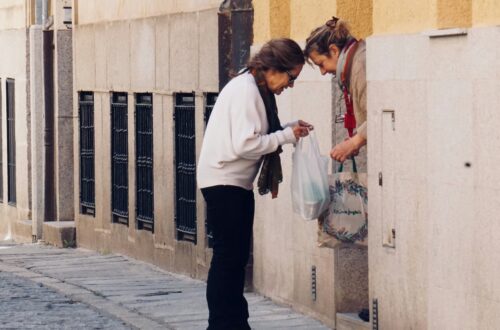








Let me just start by saying, I am not what you would call a “neighborly” person. My general policy toward the people living on either side of me has always been polite disinterest. If I see them in the driveway, I might wave. If they wave first. And only if I’m already holding my coffee mug, which creates a useful shield of plausible distraction. I’m not rude; I’m just efficiently aloof.
So when I first heard the term “radical neighboring,” I assumed it was some kind of extremist HOA movement; like maybe people going door to door to measure the height of your weeds with a protractor and a threatening smile. But no. Apparently, radical neighboring is about actually caring for the people who live near you. Not in a vague, holiday-cookie-on-the-porch sort of way, but in a very specific, very earnest, deeply inconvenient way.
It’s not charity. That’s the important distinction, and the part that confused me at first. Charity is easy: you write a check, you donate last season’s clothes, you drop off a lasagna and never speak of it again. Charity is a drive-by good deed. But radical neighboring? Radical neighboring is sticking around to eat the lasagna with someone. Even if they’re weird. Even if you’re weird. Especially if you’re both weird.
The first time I witnessed this in action was when my neighbor Carla, the kind of woman who names her plants and has very strong feelings about composting, started a “neighborhood swap shelf.” She put it outside her house with a handwritten sign that said, Take what you need, leave what you can. Which sounded suspiciously like an open bar for raccoons, but fine.
At first, it was just cans of beans and slightly expired granola bars. But then other people joined in. Someone left diapers. Someone else, a stack of mystery novels and an unopened jar of saffron (which no one took, because apparently saffron has the social energy of a wedding gift you didn’t register for). Soon, Carla added a whiteboard so people could write requests. “Size 5 shoes for boy.” “Someone to walk with in the morning.” “Need help fixing screen door.”
That’s when it got real. Because radical neighboring doesn’t end with swapping items. It escalates into swapping time, effort, emotional bandwidth. It’s a bit like joining a co-op where the currency is inconvenience. You carry someone’s groceries not because they can’t, but because doing so rewires your DNA a little, breaks the spell of modern individualism.
Of course, my participation was not voluntary at first. I was lured in. It started when I left an unopened pack of AA batteries on the shelf (generous, I thought) and came home to a thank-you note taped to my door. “You’re a gem! These powered our smoke detector. Literally saved our lives!” Now, what am I supposed to do with that? Ignore it? Frame it? Write back?
Before long, I was helping Carla build a little weather roof over the swap shelf, which is how I ended up learning to use a drill and getting into a fight about the ethics of bubble wrap. (Carla is against it. “It doesn’t biodegrade and it silences the sound of your own fragility,” she said, without irony.)
But here’s the thing: it started to feel good. Not the smug, Instagrammable kind of good, but the quietly-human kind. The kind that’s messy and reciprocal.
One Saturday, I found myself at a neighbor’s apartment helping hang curtains (badly) while her toddler watched Peppa Pig and offered me peanut butter crackers with damp hands. I didn’t particularly want to be there. I had a book waiting, a couch calling. But somehow, being there made the world feel less like something I had to endure alone. It felt stitched together (badly, sure, like those curtains) but together all the same.
The thing no one tells you about radical neighboring is that it’s not about being a better person. It’s about being a person, period. Fully embedded in the ecosystem of people. The ones who annoy you, borrow your hedge clippers, and then invite you to their cousin’s graduation party even though you once complained to the city about their barking dog.
It’s messy. It’s awkward. It’s the opposite of the sanitized, app-mediated help we’re used to. Radical neighboring is what happens when you stop seeing your neighborhood as a collection of private lives separated by drywall, and start seeing it as a community of small, daily acts of survival; and sometimes joy.
I still hide from the UPS driver sometimes. But I also know my neighbor’s mom is recovering from surgery, and I know her teenage son plays trumpet, and I know they like coconut popsicles, which I now keep in my freezer just in case. Not because I’m trying to be nice, but because somewhere along the way, I realized we’re all we’ve got.
And honestly, if that’s not radical, I don’t know what is.
Join us in making the world a better place – you’ll be glad that you did. Cheers friends.