







Remember when neighbors used to borrow cups of sugar? Not just when they were desperately out, but because borrowing and lending was just what people did.
It was a way of saying, “Hey we’re connected. We look out for each other.” But since we’ve replaced all of that with Amazon Prime and DoorDash, honestly, I think we lost something.
But over the last three weeks, I’ve had something happen (twice) that reminded me what we’re missing.
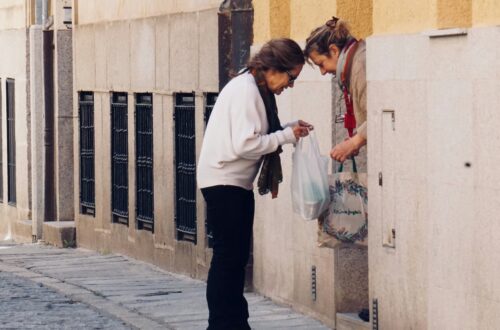
Two different women, on separate occasions, offered me their help. Not because I could pay them. Not because they wanted something in return. They simply saw that I needed assistance and offered their expertise out of the goodness of their hearts.
Now, for context, I happen to be an artistic photographer. By most standards, I’m considered quite good at it. My work hangs in galleries, and people generally seem to think I know what I’m doing with a camera. This matters because of what happened next.
After each of these women had helped me, they later came across my photography collection. And in both cases, entirely unprompted, each mentioned a particular photograph that really moved them. A piece that spoke to them in some way.
So I gave it to them.
Not as payment; that would’ve cheapened the whole thing. But as a thank you. A recognition of their generosity with something that felt equally generous from my side.
And that’s when I really saw, in action, this thing that I call the “giving economy.”
It’s not barter. It’s not tit-for-tat. It’s the building of what sociologists call social capital; that intangible web of goodwill, trust, and reciprocity that makes communities actually function. When people do things for others without the expectation of return, it has a weird way of circling back to them. Not always immediately. Not always in the form they might expect. But it literally does come back.
It’s a cycle of generosity that, many times, can be more valuable than money. Sometimes much much more valuable.
We’ve all experienced it, haven’t we? That time when someone helped you move furniture just because. When a stranger gave you their parking spot. When a colleague stayed late to help you finish a project even though it wasn’t their job. And then, weeks or months later, you find yourself in a position to help them, and you do it gladly because you remember.
The difference between the giving economy and the regular economy is this: money is a closed transaction. I pay you, you provide a service, we’re done. Clean. Efficient. Soulless.
But the giving economy? It’s messy and open-ended and human. It creates connections instead of transactions. It builds relationships instead of receipts.
The problem is, our world is increasingly optimized for transactions. Everything has a price tag. Everything is quantified, measured, assigned a dollar value. We’ve even turned ourselves into products; personal brands, monetized hobbies, side hustles. Don’t get me wrong, I’m not even remotely anti-capitalism. But I do think we’ve let it colonize spaces where it doesn’t belong.
Kindness doesn’t need a business model.
What struck me about these two encounters wasn’t just the generosity itself; though that was lovely. It was the way it created this beautiful, unexpected loop. They gave freely. I gave freely. Nobody was keeping score, but everyone came out richer.
That’s the magical nature of social capital. Unlike financial capital, it doesn’t deplete when you spend it. In fact, it grows. The more you give, the more you have to give. The more you receive, the more you want to give back.
Wouldn’t it be nice if this happened more often?
I think it could. I think it should. But it requires something that’s become almost countercultural: vulnerability. You have to be willing to need help. To admit you don’t have all the answers. To accept generosity without feeling like you owe something.
And on the flip side, you have to be willing to offer help without expecting recognition or reward. To give your time, expertise, or resources just because you can. Just because someone needs it.
It’s risky, this giving economy business. People might take advantage. They might not appreciate it. They might never reciprocate.
But you know what? That’s okay. Because the point isn’t to create a perfect system where everyone gets exactly what they deserve. The point is to create a world where people look out for each other. Where generosity isn’t the exception, it’s the norm.
Those two photographs now hang in the homes of two kind women who helped me when they didn’t have to. And every time they look at them, I hope they’re reminded that their kindness mattered. That it was seen. That it created something beautiful.
Maybe that’s the real currency of the giving economy: not photographs or favors or even gratitude, but the reminder that we’re all connected. That what we do for each other matters.
That we’re building something together, one act of unexpected kindness at a time.
Join us in making the world a better place. You’ll be glad that you did.
Cheers, friends.