








“When the dream becomes material rather than moral, it inevitably becomes empty.”
Create Who You Are
Many philosophers read The Great Gatsby as an existential novel because it subtly explores what happens when a person tries to construct meaning in a world that offers none automatically.
Human beings are born into an existence that does not arrive with built-in purpose or meaning. We exist first. Then we create who we are through the way we live. A human being simply appears in the world, and only later defines themselves through choices, actions, and commitments.
Who have you created through your choices, actions, and commitments? In short, who are you and… is it meaningful?
Our Fourth Turning
History has a rhythm. Ancient cultures understood that better than we do. But even to us, the rhythm is becoming obvious—if we’re willing to look. That’s the basic idea behind The Fourth Turning by William Strauss and Neil Howe.
They argue that societies move through long cycles (roughly eighty or ninety years), each ending in a crisis period they call a “Fourth Turning.” A time when institutions break down, old assumptions fail, and the culture is forced to rebuild itself.
The pattern is fairly clear. The 1850s gave us the tensions that erupted into the American Civil War. The 1930s were the crucible of the Great Depression and ultimately World War II. Periods when the system simply couldn’t keep running the way it had been.
And the theory appears to be holding true; we’re already inside our own generation’s Fourth Turning.
Institutions have lost legitimacy. Trust is evaporating. The economic model is crumbling. Politics has become tribal. The old order has clearly reached its expiration date.
Unfortunately, Fourth Turnings don’t drift quietly to their conclusion. They resolve through intense pressure. Through conflict. Through the forced rebuilding of systems that no longer function.
Which means the next few years will almost certainly be rough. But historically, these periods have also produced renewal on the other side. The crisis breaks things… and then, slowly, a new system begins to emerge from the rubble.
What kind of systems are we preparing to create once the dust settles?
Hopefully we’ll have enough sense to do better than we’ve done in the past.
So join us in creating something better. You’ll be glad you did.
“Dreams can inspire us, but illusions can destroy us.”
Cultivating Social Soil
The idea of “social soil” comes from thinking about communities the same way we think about ecosystems.
Just as plants don’t grow in isolation, healthy societies don’t grow in isolation either. They grow out of the conditions around them; trust, reciprocity, shared norms, mutual care, and a sense that people belong to something larger than themselves. Those conditions are the soil.
If the soil is healthy, good things grow naturally. If the soil is depleted, even the best seeds struggle.
In modern societies, a lot of our social soil has been eroded. Mobility, digital life, hyper-individualism, and transactional economics have weakened the everyday relationships that once held communities together. People are more connected technologically than ever, but socially nutrient-poor.
And from this whole metaphor, the idea of social farmers and social gardeners becomes interesting.
A social farmer focuses on the large conditions of a community. They cultivate the soil itself. They create systems and institutions that encourage trust and cooperation; things like time banks, mutual aid networks, food rescue programs, volunteer structures, and community hubs. These are the people improving the fertility of the social ecosystem.
A social gardener, on the other hand, works at the small and personal scale. They plant seeds of connection. They introduce neighbors. They organize potlucks, book clubs, and volunteer days. They mentor, encourage, and nurture relationships.
Farmers prepare the land and gardeners tend the plants. But both are doing the same deeper work: growing social capital.
And this is exactly why the concept matters right now. If we want stronger communities, we can’t just focus on solving isolated problems. We have to rebuild the conditions that allow healthy communities to grow in the first place.
In other words, instead of trying to manufacture outcomes… we start regenerating the soil.
And once the soil is healthy again, the rest tends to grow on its own.
It’s slow work.
But cultivating rich soil always is.
Ikigai (生き甲斐) is a Japanese concept that roughly translates to “reason for being” or “the thing that makes life worth living.” It’s the answer to the question: Why do you get out of bed in the morning?
In the West, ikigai is often illustrated as the intersection of four things
- What you love (passion)
- What you’re good at (talent)
- What the world needs (mission)
- What you can be paid for (vocation)
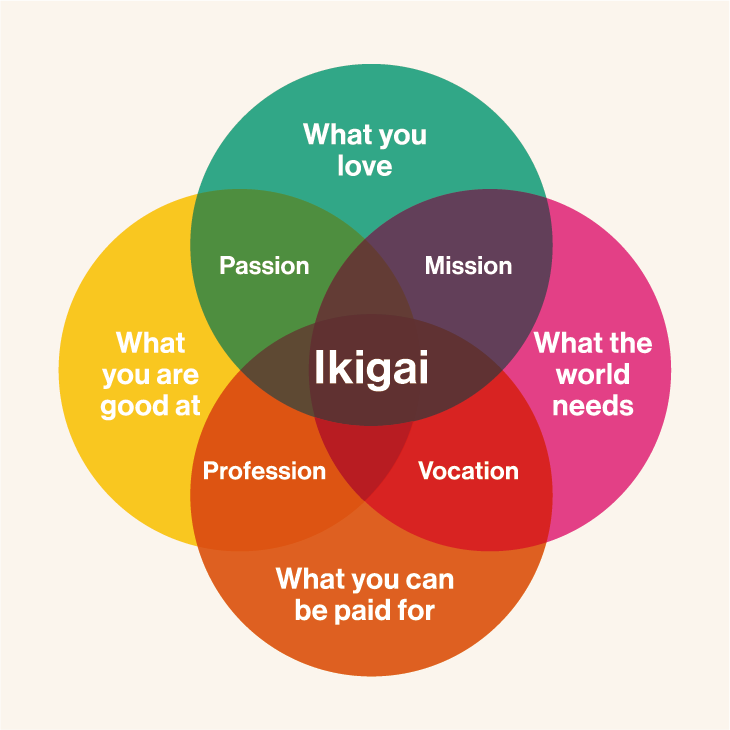
Where these overlap is said to be your ikigai; a place where meaning, contribution, skill, and livelihood align.
Interestingly, this neat Venn-diagram version is actually a modern interpretation, not exactly how the concept traditionally appears in Japan.
But I think it works really well in our modern society.
Show Up to Your Own Life
Here’s how I see it: a meaningful life is built from commitment. The people who end up shaping their own lives—and often the lives around them—are the ones who refuse to just coast. They choose something. They risk something. They relentlessly pursue the things that matter to them.
Passion gives life texture. Commitment gives it depth.
Without those, a person will drift. Comfortable perhaps, but ultimately unchanged, leaving little behind.
But when someone throws themselves fully into a purpose, they become the kind of person who creates meaning. The kind of person who makes a difference. They become interesting. Magnetic. Alive.
They’ve shown up fully to their own life.
And that is how impact happens. A person who is fully engaged in their life doesn’t just improve their own story—they add weight and substance to the world around them.
Others Have Excuses, I Have My Reasons Why
The progressive bluegrass band Nickel Creek released a song 25 years ago with a line that I’ve always found fascinating:
“Others have excuses, I have my reasons why.”
And I think it can be taken two ways. Google’s AI takes the position: The line highlights a distinction between making flimsy justifications (excuses) and having legitimate, deeper explanations for one’s actions or failures.
I, on the other hand, have always looked at it this way: We tend to think that other people’s “reasons why” are excuses, while our “excuses” are reasons why.
I think we frequently want to justify our behaviors rather than take an honest, and often painful, look at what really motivates them. But self-understanding is one of the most important aspects of wisdom.
So… do you have “excuses”, or “reasons why”?
Probably a combination of the two, but it’s important to take an honest look at this question.
Cheers
You’re Not Normal
How many times have you heard or used the phrase, “That’s not normal”? The idea of “normal” is so deeply ingrained in our psyche that we rarely stop to question what it really implies.
But what is normal? And how does it differ from being normative?
We might use “normal” to denote what’s seen as typical, habitual, or routine. Biologically speaking, normal signifies the state of an organism operating as expected, free from irregularities or deviations.
However, the fascinating thing about biology is its inherent diversity. Each living being is born with variations that make it slightly different from the so-called ‘ideal’ – and these differences aren’t necessarily detrimental, but rather a testament to the marvels of diversity.
So many times, we’re judged, or judge others, for “not being normal”. We think this group or that group is bad because they are different from what we consider “normal”. But I hate to be the one that breaks it to you – you aren’t normal either. No one is normal. Most people learn, over time, to behave normatively to cover up their lack of normalcy and fit in better, but no one is actually “normal”.
A Zen master of times past is credited as having said “I’m perfect… perfectly myself”.
So, the next time you find yourself judging another person or group of people for not being “normal”…
Think again – weirdo. 😁
Our Faustian Bargain
A Faustian bargain is a trade where the short-term gain is so seductive that we ignore, or underestimate, the long-term cost.
And the modern world has made such a bargain – to its great detriment. We’ve made a kind of collective deal; not with a literal devil, but with systems we’ve built. We traded:
- Community for convenience
- Meaning for efficiency
- Privacy for connectivity
- Long-term stability for short-term growth
At first, it gave us this ecstatic high of false abundance.
- Technology gave us speed
- Medicine gave us “longevity”
- Markets gave us “abundance”
- Algorithms gave us “personalization”
And, for a moment, it felt like we had outsmarted the limits that bound every civilization before us.
But there’s always a catch in a Faustian story: The cost doesn’t show up immediately.
It was intoxicating. Like Faust at the beginning of the deal – limitless possibility. And it didn’t feel like we sold our souls outright. It felt like we were just leasing them, one convenience at a time. We thought that we could get out of this lease anytime we wanted. Any time it became inconvenient or too costly. But that’s not how a deal with the devil works.
We made the deal for the same reason Faust did. Because we were foolish. Because we were human. We wanted relief from suffering. We wanted control over uncertainty. We wanted to transcend limits. We wanted more time, more comfort, more… everything.
And when something comes along that promises all of that? We rarely ask, “What will this cost me later?” We ask, “How soon can I have it?”
But now that we’re here, and even though reneging on a deal with the devil may well be impossible, our Faustian story, like all Faustian stories, hinges on one thing:
Is it too late to reclaim what was traded?
And that’s where the work around community, reciprocity, and social capital is a bit of a counter-move. A refusal to accept the terms of the deal our forefathers made.
Because maybe the answer to this bad situation in which we find ourselves is to reintroduce the things we traded away:
- Real relationships
- Mutual obligation
- Presence
- Meaning that isn’t mediated or monetized
And maybe this is the deeper insight: A Faustian bargain only holds as long as we keep honoring it. Maybe we do have the power to break free. Maybe we can renegotiate. But it will require awareness and a willingness to give something back. To let go of the enticements that have been holding us in this contract for so long. Convenience. Speed. Sense of control. The very things that made the deal so tempting in the first place.
And maybe the damage is too serious to undo at this point, but we have to try. Where’s the harm in trying? What do we have to lose?
Our souls, if we don’t do something about it.