




A Few Quality Things
I talk a lot about quantity versus quality. And since the post-war manufacturing boom, society and the economy have been more and more geared toward quantity.
But now we’re in a very interesting place. Because the world is about to present a strange contradiction. We are going to have less quantity of material things available to us – and I propose that we all switch gears and start focusing on quality when it comes to material goods.
But we are also being hit with a massive increase in the quantity of non-material goods: information. AI content generators are about to flood the internet with billions of new posts, articles, and images.
Information and content are already ubiquitous, and they are going to grow exponentially.
This is a very odd situation to be in. Outside of our heads, we are being forced to shift to lower quantity – and hopefully compensate with higher quality. But inside our heads, the reverse is true. We are being forced to shift to higher quantity, which necessarily drives a shift to lower quality. A quantity tsunami is building, and it will take deliberate effort to resist it.
This is going to be a very weird balancing act, and I propose that we prioritize quality over quantity in all aspects of our lives.
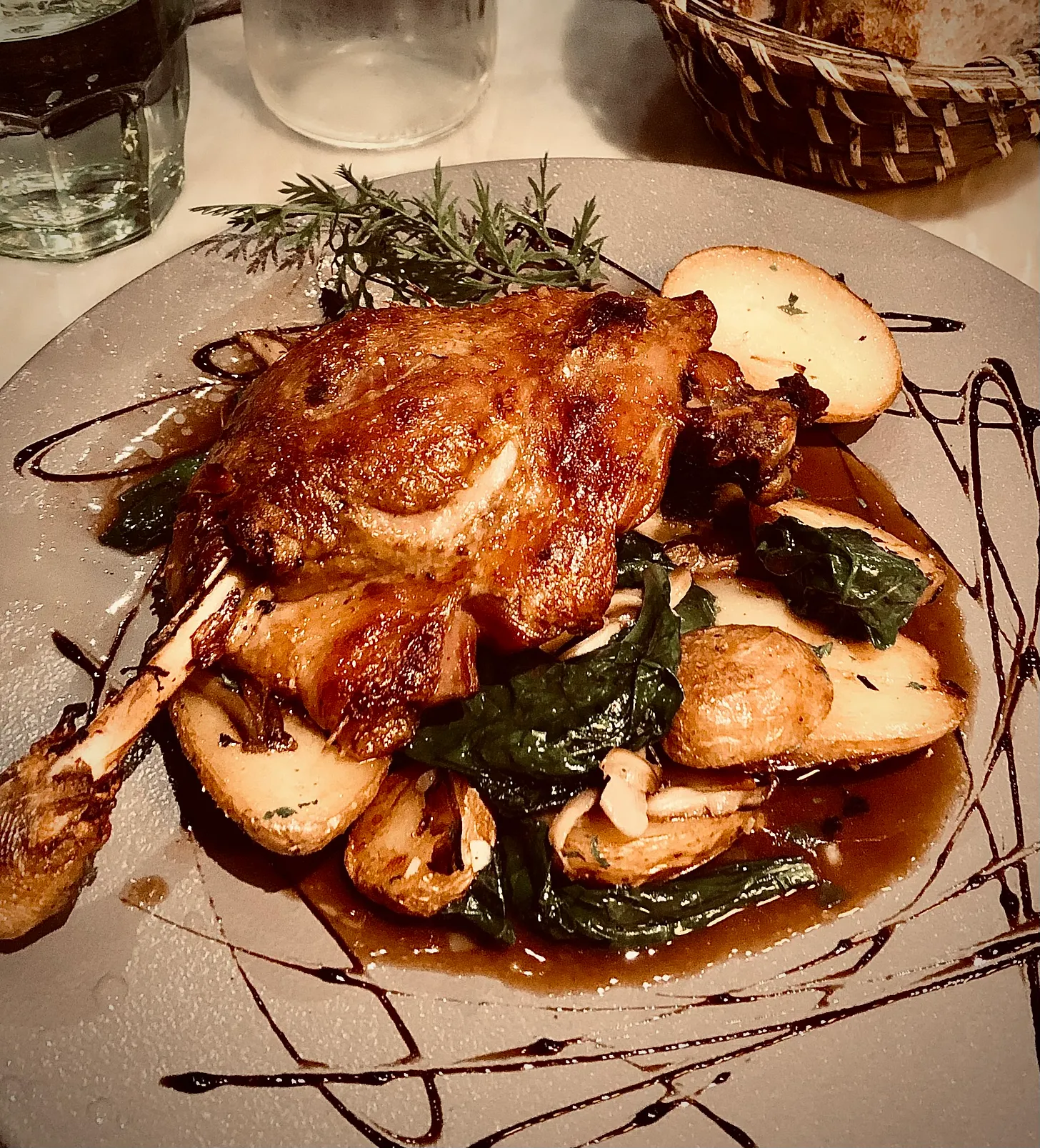
A few quality things, material or not, are far more meaningful than a mass of poor-quality anything.
So, slow down. Look for quality – in all things. And don’t be swept away by the quantity tsunami.
If You Know, You Know
Everyone needs an identity, right? Especially when we don’t know who we are.
When someone doesn’t truly know themselves, then they look for external qualifiers to define who they must be. I mean, if I don’t know who I am, maybe society can tell me.
I’m a doctor. I’m a lawyer. I’m a philanthropist. I’m a mechanic. I’m a priest. I’m a mother. I’m a Buddhist. I’m a Canadian. Etc.
But what I’ve found interesting, in my long life, is that the more you get to know yourself, the more you come to know who you really are. You find that you no longer need those labels that come from outside of yourself.
And eventually, you don’t need a label at all.
Because when you know, you know.
Quote by Denzel Washington: “It’s not about what you have or even what you’ve accomplished. It’s about what you’ve done.”
Gerard v. Centola; and how they work together
Many of us don’t actually come up with our own ideas and desires; we borrow them. We see what others value and we start valuing it too. That’s the idea behind René Girard’s mimetic theory. But Damon Centola adds something important: it doesn’t really stick unless it’s reinforced.
One person modeling something different might catch your attention, but a small group living it out together? That’s when it starts to seem like a real option. That’s when it becomes potentially “contagious” (to borrow Centola’s language).
Society and culture are shaped by what we see people around us consistently choosing. Together. Over time.
This tells us that changing a community isn’t just about convincing people of something new; it’s about making a different kind of desire visible, and then surrounding it with enough people that it starts to feel like the obvious choice.
As I always say, “beat a drum, build a tribe, start a movement”.
Work Smarter v. Convenience Culture
What’s the difference between working smarter and convenience?
“Work smarter, not harder” is about intentional efficiency. It assumes the work matters. The goal matters. You’re not trying to avoid effort; you’re trying to apply it well.
It’s the difference between swinging wildly with a dull axe and pausing long enough to sharpen it. The effort is still there, but it’s focused, thoughtful, leveraged. There’s a kind of discipline to it.
Convenience culture, on the other hand, is about removing effort wherever possible.
Not just unnecessary effort; all effort. It doesn’t ask whether the effort is meaningful; it just asks how quickly it can be bypassed.
And over time, that starts to reshape us. We get used to not waiting, not struggling, not engaging deeply. Everything becomes faster and easier… even the things that probably shouldn’t be.
One still respects the process. The other slowly forgets why the process mattered in the first place.
You can feel it in real life. A craftsman finding a better technique still cares about the craft. Someone ordering everything through an app starts to lose touch with how anything works at all.
That’s the defining line between the two.
One makes you sharper. The other makes life smoother… but sometimes at the cost of becoming a little duller yourself.
And the trick, I think, is knowing which efforts are a waste… and which efforts actually help to form who you are.
We’re All Just Lab Rats
B.F. Skinner discovered that variable rewards (unpredictable, intermittent reinforcements) create the most persistent and compulsive behaviors.
His operant conditioning experiments, such as lab rats or pigeons pressing levers for random treats, showed that unpredictable rewards, known as variable ratio schedules, produce faster response rates and higher resistance to extinction than fixed, predictable rewards.
You can almost feel it; if you pay attention. Everything in our world is like a Vegas slot machine. And the Internet is built to be the biggest, most engaging “slot machine” imaginable.
What B. F. Skinner uncovered in the lab (those variable, unpredictable rewards) has become the operating system of our internet addicted lives. And the platforms, to which we have utterly surrendered, didn’t just stumble onto this idea. They planned it from the beginning.
Infinite scroll is probably the clearest example. There’s no stopping the cue. No “you’ve reached the end.” Just one more swipe – each swipe a pull of the lever. Maybe this next post is interesting. Maybe it’s funny. Maybe it’s something that will give me that much-needed hit of dopamine I’m jonesing for.
Most of the time… it’s nothing special. But sometimes? Sometimes, it lands. That unpredictability is the hook. Your brain learns: keep going, the next one might be it.
And notifications are the little digital taps on the shoulder. But you don’t know what they are until you check. A like? A comment? Something important?
Or just noise.
That uncertainty matters more than the content itself. If every notification were predictable and low-value, you’d ignore them. But because some are meaningful, you check all of them.
That’s textbook variable reinforcement.
You post something… and then you wait. Will it land? Will people respond? Sometimes you get a flood of likes, a thoughtful comment, or unexpected attention. Other times… almost nothing. That inconsistency is what keeps you coming back. It’s social validation on a variable schedule, which is even more powerful than food pellets for a lab rat.
But platforms don’t just give random rewards; they learn what rewards you.
Through data, algorithms:
- Track what you linger on
- What you click
- What you react to
And then they tune your feed to maximize:
- Occasional hits
- Mixed with enough misses
Too many hits? You get bored. Too many misses? You leave. So they calibrate the perfect unpredictability.
Skinner needed a lab. Platforms have billions of willing human participants running the experiment in real time. And unlike Skinner’s rats, who were forced to participate in the experiment, we humans pay for the privilege.
Mimetics… What?
The idea that repetition rewires the brain is exactly why communities of practice matter.
What we see, over and over, starts to feel normal… and then it starts to feel desirable (mimetics). Culture isn’t just what we believe; it’s what we repeatedly witness people around us doing. Most people don’t consciously choose their desires, they absorb them.
But if you’re intentional about the environment, about what’s visible, about what gets repeated, you can actually shape the direction of that absorption. Not in a manipulative way, but in a clarifying way. You make a different way of living visible, consistent, and real enough that people can say, “oh… that’s an option.”
And once that happens, once something feels like a real option, it can spread.
René Girard would say no one is fully outside mimetic desire. Not even the strong, self-directed types.
But I would disagree, somewhat.
I feel like René Gerard’s mimetics idea is valid for people that are fairly impressionable; which unfortunately is the vast majority of the population. However, I think that people with strong ideas of who they are and what they believe are not so easily swayed by popular movements.
I think people of substance stand on their own ideas and are perfectly willing to swim against the current if the current runs contrary to what they feel is reasonable.
But Gerard would argue: on the surface, yes; there are clearly people who are less reactive. They don’t chase trends. They don’t bend easily to social pressure. They’re willing to be out of step.
And Girard’s deeper claim is more even more curious:
We don’t just imitate behaviors… we imitate desire itself.
So even the person who “stands alone” is still shaped by models – they’ve just chosen different ones.
Not the crowd… but a mentor. Not trends… but a philosophy. Not popularity… but a standard
So, I think he would say that the imitation doesn’t disappear. It refines.
But I think that there’s a difference between unconscious imitation and conscious alignment.
And I would argue that most people absorb desires passively:
- “Everyone wants this, so I want it too.
- “This is what success looks like, I guess.”
But some people slow that process down. They examine it. They ask:
- Why do I want this?
- Who taught me to want it?
- Does this actually fit me?
That’s where I feel “substance” shows up; in being intentional about which influences you allow to shape you.
And there’s maybe another layer here:
To play devils advocate; some might say that those who are grounded often look like they’re swimming against the current…
but in reality, they’ve just tuned themselves to a different current.
They’re not outside the system. They’ve just opted into a different signal.
So, I guess, in summary:
Most people don’t come up with their desires, they inherit them. That’s Girard. And he’s right more often than we’d like to admit.
But there’s another side to it. Some people learn to step back and examine what they’re inheriting. They don’t just absorb, they filter. That doesn’t mean they’re free from influence. It just means they’ve chosen their influences more carefully.
And that’s probably the real dividing line: not between people who imitate and people who don’t, but between people who do it unconsciously and people who do it on purpose.
As much as I would like to think that I’m utterly independent in my thought, I am woefully influenced by the content on Substack.
So there you go. My thoughts.
How to Change the World
Culture is environmental (beat a drum)
Networks are relational (build a tribe)
Systems are structural ( start a movement)
All three must be aligned in order to make change.
More on Changing the World
In all my work with time banking (which is considerable), I identified (early on) that the idea hasn’t been struggling because it isn’t a good idea; it has struggled because it started at the wrong layer (culture, network, systems). It went straight to the system. Build a platform. Track the hours. Create the exchange. Try to convince people to adopt it.
But people don’t participate because something makes sense. They get involved because they start to see it as a normal part of daily life; because the people around them are doing it, it’s become routine, it’s become a part of the fabric of living.
And this process of adoption has to start at the cultural layer.
If the culture isn’t there, if helping each other still feels like the exception rather than the rule, and if the relationships aren’t strong enough to carry trust, then the system just… fizzles.
People in the time banking movement always assumed that behavior would follow structure. But it’s usually the other way around. Culture shapes what people want. Relationships make it feel real. This is the soil in which to plant systems. When the soil is prepared and ready to take the “seed” of a system, then (and only then) can we plant it.
Trying to plant a seed in soil that is not fertile, is a truly futile task.
And this, I wholeheartedly believe, is why the time banking movement has never really caught on.
So, my time banking friends, enrich the soil first; start the cultural movement, build the networks, then build the systems.
If you can do this, you will make real change.
I Have Such an Interesting Life
I get up early in the morning and meditate. Then journal for a while. Plan my trip to Portugal to find an old farmhouse to renovate. Work on converting a van into the perfect camper. I meet friends in a café for dinner. Work on my novel. Then spend the rest of the evening in the arms of the most amazing man.
Oh wait a minute. Those were YouTube videos.
Isn’t that almost as good as actually doing it though? Doing it vicariously.
Close enough, I guess.
Dammit. I’m out of Cheetos.
We Are the Digital Hermits
We’ve all heard of the digital nomad. That modern-day adventurer. That person living out the dreams that we somehow never got around to. That person who had the guts and motivation to set out into the big scary world to live their life with gusto – the contemporary Hemingway types.
But there’s also the other kind of digital lifestyle…
The digital hermit.
The rest of us dreamers who never quite found the wherewithal, for whatever reason, to dive into the deep end of the pool of life.
We chose the safer path. Passing the days watching others live our adventures. Leaving the house less and less. Watching our screen time trend upward. Ever-expanding waistlines. Declining health. Fewer and fewer face-to-face social interactions.
We are the digital hermits. The majority who never quite got around to that summer in Paris. Or the road trip up the PCH we were meaning to take. Or, frankly, anything else.
But, we do have a premium YouTube subscription and, with Amazon Prime, we can just get bigger pants.
The Great George Costanza
once said: “it’s not a lie if you believe it”.
How many times do we lie to ourselves… or to others? And how much of our reality is shaped by those lies?
“She’s not cheating.”
“He really does like me.”
“No, my ass doesn’t look fat in these jeans.”
“I’m sure that pain is nothing.”
“The government would never lie.”
The sad fact is that life is full of lies—told to ourselves and to others. Politicians call it spin. Corporations call it marketing. We call it a coping mechanism. But a lie is still a lie, by any other name. And we’re not doing ourselves, or each other, any favors by skirting the truth.
I’m not saying we should be rude to one another. A little white lie, now and then, to spare someone’s feelings… that’s not a bad thing. But self-delusion, or manipulating others, isn’t harmless. It’s destructive.
And right now, we could all use a little more truth.
Even if it’s hard to swallow.
The Dude Abides… Indeed! Lol
So I’m watching The Big Lebowski and I asked ChatGPT what the social and philosophical implications were. And this took me down an unexpected rabbit hole.
Did you know that there’s a “religion” based on this character – the Dude? Oh yeah. It’s called, wait for it…
Dudeism.
Their website describes it as the slowest-growing religion in the world — a philosophy that preaches non-preachiness, practices as little as possible, and is perfectly fine taking a nap before getting back to you.
So, basically, Dudeism is what happens when someone looks around at all the shit of modern life and decides to say… “no thanks”. It’s maybe not quite laziness — maybe more like restraint. It’s the decision to stay grounded when everything is trying to pull you into the, well… shit.
There’s maybe a little Taoism in it, but mostly it’s just stoner common sense: life works better when you stop trying to force everything and just move with it, man. You know — show up, be decent, and abide.
Dudeism, I guess, is the act of saying… not everything deserves my energy — and then living like you mean it.
Just call me… the Dude.
“Sometimes you eat the bear. And sometimes, the bear eats you”
At one level, it’s just life without the illusion of control. Some days things break your way. Other days, they don’t. Its just… the turn of things, man.
But underneath that, it’s almost a rejection of the idea that we’re always supposed to be winning. Culture treats losing as a surprising event. Like… “That’s not supposed to happen”. And yet, the reality is; sometimes you’re on top, sometimes you’re not. That’s not always a failure. That’s life, really.
There’s also something humbling in it. You’re not the center of the story. You’re in it; but you’re also subject to it. You push. The world pushes back. And no amount of force fully removes that reality.
But strangely… it’s kind of freeing (in a Dude-ish way).
Because if sometimes the bear eats you, then you don’t have to take every loss as a referendum on your worth. You don’t have to beat yourself up every time things go sideways. You just… get back up when you can, brush it off, and keep going.
It’s very Dude-like, actually. Not passive. Not defeated. Just… not surprised when it comes.
Maybe it’s like this: Life isn’t necessarily something you conquer. It’s a wave you ride. Sometimes well. Sometimes not.
Either way… you keep abiding.