





Executive Summary
Modern society is experiencing a crisis of fragmentation.
Communities are dissolving. Institutions are losing trust. Economic systems increasingly reward extraction over contribution. People are more digitally connected than ever before, yet profoundly isolated from one another.
This white paper proposes a different framework for understanding the future of society and economics:
That the most valuable form of capital may not be financial capital at all… but social capital.
Human civilizations have always functioned on trust networks. Long before modern banking systems, contracts, or digital currencies, communities survived through reciprocity, reputation, cooperation, and mutual obligation. Modern systems obscured this reality but never replaced it.
The work of KommunityKoin, the broader Re-Community framework, and the philosophical work developed through The Koin Blog proposes that humanity is entering an era where rebuilding social infrastructure may become one of the most important economic and cultural tasks of the 21st century.
This paper outlines:
- The collapse of social cohesion in modern society
- Why downstream systems are failing
- The economic value of social capital
- The concept of the “Economy of Trust”
- The role of reciprocal communities and time co-ops
- Why localism and social infrastructure matter
- How emerging technologies can strengthen human relationships rather than replace them
- A practical framework for re-seeding dying communities
This is not merely a social theory. It is a systems framework for cultural resilience.
The Problem: A Civilization Rich in Wealth but Poor in Connection
Modern industrial civilization achieved extraordinary productive capacity. It created abundance of goods, information, and technological capability unprecedented in human history. Yet despite this material abundance, many societies are experiencing:
- Rising loneliness
- Declining trust
- Political polarization
- Mental health deterioration
- Community collapse
- Economic precarity
- Declining civic participation
- Institutional distrust
- Cultural fragmentation
The issue is not merely economic. It is relational. Modern systems increasingly treat humans as isolated economic units rather than embedded members of living communities.
Many systems optimize for efficiency while unintentionally destroying the very social bonds that make societies resilient. Communities become transactional. Relationships become commodified. Human value becomes reduced to productivity and consumption. The result is a society that may be technologically advanced while simultaneously becoming socially brittle.
This is the core insight behind the Re-Community framework presented through RiverStephens.org/Re-Community. The future stability of civilization may depend less on GDP growth and more on rebuilding social cohesion.
The Failure of Downstream Thinking
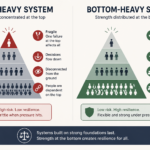
Modern institutions largely operate downstream. They intervene after collapse has already occurred. Healthcare systems often wait until people are sick. Social services intervene after crisis. Economic systems respond after instability has spread. Political systems react after social trust has already eroded. But many societal crises are not isolated failures. They are symptoms of deteriorating social infrastructure.
The essay “Upstream Is Not Charity” argues that upstream intervention is not merely morally desirable; it is economically rational.
Healthy communities reduce downstream costs. Strong social networks improve resilience, health outcomes, economic mobility, and collective stability. Research consistently demonstrates that social capital significantly influences economic and societal outcomes. The implication is profound: If trust and community reduce downstream societal costs, then investing in social infrastructure may produce measurable economic returns.
In this framework, community itself becomes infrastructure.
Social Capital: The Invisible Economy
Social capital refers to the value created through relationships, trust, reciprocity, reputation, and cooperation within networks of people. Historically, societies depended heavily on this invisible economy.
- Neighbors helped neighbors
- Families supported one another
- Communities shared responsibility
- Reputation mattered
In small communities, contribution was visible. People knew who helped and who did not. Modern society obscured these dynamics through institutional outsourcing and hyper-individualism. Yet the underlying reality never disappeared.
Human societies still run on trust.
The concept behind KommunityKoin is that social contribution itself has measurable value, even if modern economies often fail to recognize it. This is not about replacing money. It is about recognizing that not all value is financial.
- Caregiving
- Volunteerism
- Mentorship
- Mutual aid
- Community leadership
- Social coordination
- Trustworthiness
These things create enormous value while often remaining economically invisible. The central proposition of the Economy of Trust is simple: Communities become stronger when contribution becomes visible again.
Reputation as a Form of Capital
Throughout history, reputation functioned as a form of currency. A trustworthy person gained access to opportunities, support, cooperation, and social standing. In many ways, modern digital systems are unintentionally rediscovering this reality. Online marketplaces, decentralized platforms, freelance economies, and peer-to-peer systems increasingly rely on reputation systems.
But current reputation systems are fragmented and often optimized for commercial engagement rather than community health. The vision behind KommunityKoin proposes a different direction: A framework where communities recognize meaningful contribution as a form of social capital. Not performative status. Not influencer culture. Not algorithmic popularity.
But genuine contribution to collective well-being. The distinction matters. Modern systems often reward attention. Healthy communities reward contribution.
Re-Community: Rebuilding Social Infrastructure
The Re-Community concept begins with a simple observation: Many communities are becoming social deserts.
- Food deserts
- Healthcare deserts
- Opportunity deserts
- Relationship deserts
Modern society often attempts to solve these problems through increasingly centralized systems. But centralized systems frequently struggle to rebuild local relational networks because trust itself is local. The Re-Community framework proposes re-seeding communities by rebuilding local social ecosystems:
- Community food systems
- Mutual aid networks
- Time co-ops
- Community health initiatives
- Local education systems
- Skill-sharing networks
- Civic participation structures
- Localized digital communities
- Social infrastructure rooted in reciprocity
This approach views communities not merely as geographic areas but as living relational systems. Strong communities produce resilience. Weak communities produce dependency and fragmentation.
The River Stephens Framework: Culture, Networks, Systems
The broader framework developed through River’s Framework argues that sustainable societal change occurs through the interaction of three layers:
Culture: What people believe. What they imitate. What becomes normalized.
Networks: How people connect. How behaviors spread. How trust forms.
Systems: The institutional structures built on top of culture and networks.
Many reform movements fail because they begin at the systems layer. But systems unsupported by culture and relationships rarely sustain themselves. People do not participate simply because something is logical. They participate because behaviors become socially reinforced and culturally meaningful.
This framework aligns with growing research showing that networks strongly influence behavioral adoption, trust formation, and economic mobility. The implication is that rebuilding society requires strategic reweaving of all three layers simultaneously. Not merely policy change. Not merely technology. Not merely ideology. But relational ecosystems.
Technology as a Tool for Human Coordination
Technology itself is not the problem. The question is what systems technology optimizes for. Many digital platforms optimize for:
- outrage
- addiction
- engagement extraction
- surveillance capitalism
- algorithmic manipulation
But technology can also strengthen:
- coordination
- reciprocity
- trust networks
- community participation
- local resilience
This is the philosophical direction behind KommunityHub and related community-building platforms. The objective is not to create another mass social media platform. It is to create infrastructure for local social cohesion. The future may belong less to mass social media and more to “communities of communities” — interconnected local networks capable of preserving human-scale relationships in an increasingly abstract world.
Why This Matters Now
The coming decades will likely place enormous strain on existing systems.
- Economic instability
- Automation
- AI disruption
- Healthcare pressures
- Political polarization
- Institutional distrust
- Demographic shifts
- Climate instability
Large centralized systems may become increasingly fragile under compounded stress. Communities with strong social cohesion will likely prove more resilient than communities dependent entirely on distant institutional systems.
This is why rebuilding social capital is not nostalgic romanticism. It may become a practical survival strategy. Strong communities distribute risk. Weak communities amplify collapse.
Conclusion: The Future May Depend on Trust
Human civilization did not begin with financial systems. It began with relationships. With trust. With reciprocity. With cooperation. With people depending on one another.
Modernity created extraordinary tools but often weakened the relational fabric that made civilization stable in the first place. The Economy of Trust framework proposes that the future may require reintegrating these forgotten realities into modern systems. Not abandoning technology. Not rejecting progress. Not dismantling markets. But remembering that economies ultimately exist to serve human flourishing.
The central question of the coming century may not simply be: “How do we grow the economy?” But rather: “How do we rebuild societies where people trust one another enough to create meaningful futures together?” That is the work of Re-Community. That is the work of rebuilding social capital.
And perhaps… that is the work of becoming human again.
References & Foundational Sources