







A Modern Kula Ring for Communities
When I first heard about the Kula Ring, it sounded like the sort of invention that would only make sense if people had too much free time on their hands. In the Trobriand Islands, men would sail hundreds of miles to exchange shell necklaces that traveled clockwise and shell armbands that traveled counterclockwise.
No money changed hands. No one got rich. Yet somehow this strange ritual bound entire communities together. I couldn’t help but think that if someone tried to pitch this idea in a city council meeting today, they’d be escorted out with a polite but firm suggestion to seek professional help.
But then again, maybe the islanders were onto something. Our modern neighborhoods are full of houses but strangely short on neighbors. We wave at each other from across the lawn, and if we’re feeling generous, we exchange small talk about the weather, but that’s usually the extent of it. What if instead of limiting our generosity to waving, we created our own modern Kula Ring, not with seashells, but with something that could carry meaning in our daily lives?
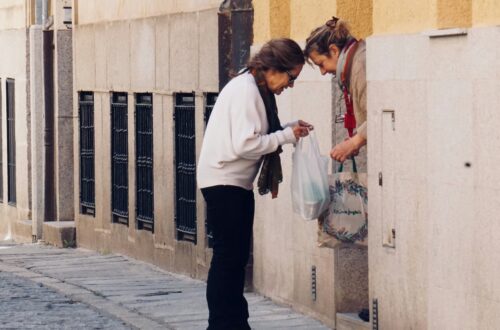
Let’s try to envision a community where instead of just giving a neighbor a casserole when they’re sick, you loan them your time and skills and they pass the act of kindness along to someone else who needs it, and so on, until you discover that your goodwill has made it halfway across town like a miniature Marco Polo. Your act of kindness might come back the same as it went out, or possibly much different, but either way it would have stories. And stories are the real currency of community.
Of course, this requires trust, which is in shorter supply these days than kale at a barbeque. Yet the beauty of the Kula Ring wasn’t just the shells themselves; it was the repeated acts of giving that made everyone interdependent. It wasn’t about hoarding, it was about circulation. Communities today could use more circulation, not of gossip, which already moves at lightning speed, but of things that make life easier: tools, skills, time.
Think of it as a living network of goodwill, with each exchange carrying a whisper of accountability. The mechanic helps the teacher with a car problem, the teacher tutors the mechanic’s kid, the kid bakes cookies for the elderly neighbor, and the neighbor watches the dog for the traveling nurse. Each act might be small, almost laughably ordinary, but strung together, they forms a ring of value that no economy of credit cards and monthly subscriptions can replicate.
Critics might argue this is all quaint and idealistic, and maybe it is. But then again, isn’t it more absurd that we rely on Amazon to ship us things from a warehouse thousands of miles away while our next-door neighbor owns the very object we need? It’s as if we prefer the inconvenience of convenience. A modern Kula Ring wouldn’t solve all our problems, but it might remind us that survival and even comfort come less from the things we buy and more from the people we can rely on.
And perhaps the most humorous irony is this: when a system of sharing actually works, someone usually tries to monetize it, slap a shiny logo on it, and turn it into yet another app with premium features. That’s the point where the spirit of community often collapses under the weight of capitalism.
What we’re trying to do is the opposite. We’ve created a space where the Kula Ring idea can live in the modern world without losing its soul. It’s not about squeezing profit out of people, but about giving them the tools to exchange value, build trust, and rediscover what it feels like to be part of a real community rather than just blocks of people paying mortgages side by side.
Join us in making the world a better place. You’ll be glad that you did.
Cheers, friends.