




Ernesto Van Peborgh once offered a metaphor that is, frankly… very cool. (And, thank you to Kelly Clark for telling me about it.)
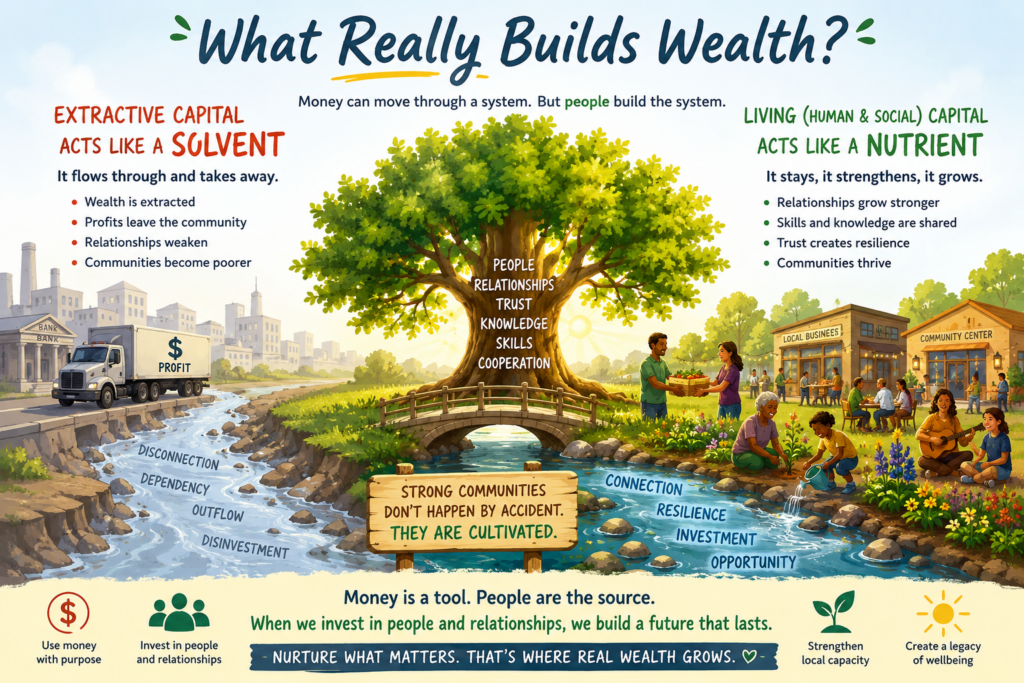
He suggested that extractive capital (money) acts like a solvent as it moves through a system, while living capital (human and social capital) acts like a nutrient.
The more I think about that metaphor, the more I believe that might be one of the most important ideas I’ve heard lately.
Most of us have been taught to see money as the primary measure of value. We assume that if more money is flowing, things must be getting better. But anyone who has spent time in struggling communities knows that isn’t always true.
Money can flow through a place like a river and leave very little behind.
A corporation arrives. Wealth is extracted. Profits leave the community. Local businesses disappear. Relationships weaken. Young people move away. The numbers may look good on paper, yet somehow the community itself becomes poorer. That is the nature of a solvent. A solvent dissolves things. It breaks bonds apart. And money often behaves this way.
I’m not saying this is because money, in itself, is evil; but money is mobile. It can leave. It can be concentrated. It can be accumulated without any obligation to the people or places from which it came. But human capital… that behaves differently.
Knowledge shared between neighbors does not disappear when it is given away. Trust built between friends tends to grow stronger through use. Skills passed from one generation to another become part of a community’s collective resilience. Social capital (the web of relationships that connects people together) creates capacities that no amount of money can purchase outright.
These things function more like nutrients.
A nutrient strengthens the organism. It increases vitality. It helps life reproduce itself. And healthy communities are rich in nutrients. People know one another. They help one another. Information travels. Skills circulate. Children have mentors. Elders have purpose. Local institutions cooperate. People trust that if hardship comes, they will not face it alone.
That kind of trust is wealth. Not metaphorically, either. Literally.
If your roof blows off during a storm and ten neighbors show up to help repair it, that is real value. If someone teaches you a skill that helps you earn a living for the next twenty years, that is real value. If a community garden feeds families, if volunteers support a struggling parent, if local organizations coordinate resources efficiently, value has been created regardless of whether money changed hands.
The modern economy often mistakes the accounting system for the thing being accounted for. And, as I have been touting of late… Money is not value. Money is a claim on value. The value itself resides in people, relationships, skills, trust, knowledge, and cooperation. Money merely records and transfers claims against those things.
This is why communities can become economically wealthier while simultaneously becoming socially poorer. The solvent is flowing, but the nutrients are disappearing.
Perhaps the challenge before us is not to reject money. Money remains useful. We need accounting systems. We need markets. We need exchange. But we also need to remember what actually creates thriving communities.
The future will belong to the places that learn to cultivate nutrients as carefully as they pursue revenue. Places that invest in trust as deliberately as they invest in infrastructure. Places that understand that human beings are not merely units of production but living assets whose relationships create extraordinary value.
Because when the next crisis arrives, and it always does, it won’t be money that saves us first.
It will be each other.
That’s why I think this is such a powerful metaphor; because it captures something many people intuitively sense but struggle to articulate.
But, to dig deeper…
The first thing I’d say is that Van Peborgh’s metaphor is directionally true, but like all metaphors, it isn’t universally true. Money can act as a solvent, and human/social capital can act as a nutrient. But money can also function as a nutrient under the right circumstances.
I think that the emphasis of the metaphor was the word “extraction”. Money isn’t always extractive, but when it is… oh boy.
For example, when capital is invested in local businesses, schools, healthcare, infrastructure, or community institutions, money can strengthen relationships and capacities rather than dissolve them. A small business loan can create jobs. A scholarship can develop human capital. A grant to a nonprofit can expand social capital. In those cases, money is feeding the system rather than extracting from it.
The distinction, I think, is not money itself but whether capital is circulating regeneratively or extractively.
That idea aligns closely with much of my own work.
I’ve often argued that the real wealth of a community resides in its people, relationships, trust networks, skills, institutions, and mutual aid capacity. Money matters, but it is secondary. If the social fabric is strong, communities can survive surprising levels of economic hardship. If the social fabric collapses, vast amounts of money often fail to solve the underlying problems.
A useful thought experiment is to imagine two towns.
The first town has a high average income but low trust. Neighbors don’t know one another. Civic organizations are weak. Volunteerism is rare. People feel isolated. Every need must be purchased through a market transaction.
The second town has lower income but strong relationships. People share tools. Churches and nonprofits are active. Neighbors help one another. Information travels quickly. People feel connected and supported.
Which town is actually wealthier?
Traditional economics would almost certainly choose the first. Yet many people would prefer to live in the second. That’s because human beings experience wealth as more than purchasing power. We experience it as belonging, security, meaning, reciprocity, competence, and trust.
Where I think this metaphor becomes especially interesting is when viewed through systems thinking. A solvent breaks bonds. A nutrient strengthens living systems. If that’s true, then one of the central questions of economics becomes:
Does this activity strengthen relationships or weaken them?
Does it increase local capacity or reduce it Does it create dependency or agency? Does it build trust or erode trust?
Those questions rarely appear on balance sheets, yet they may tell us more about the long-term health of a community than many financial metrics. In fact, I suspect this metaphor points toward a larger paradigm shift that runs through much of my framework:
We have spent centuries measuring the flow of money and calling that wealth. The next economic evolution may involve measuring the condition of the human networks that create wealth in the first place.
In that sense, social capital isn’t merely another form of capital. It may be the substrate upon which every other form of capital ultimately depends. After all, every dollar, every institution, every market, every contract, and every organization rests on one invisible foundation:
Trust.
Without trust, the entire system stops functioning. With trust, communities can accomplish extraordinary things even when money is scarce. That’s why I find this metaphor so compelling. It redirects attention away from the accounting system and back toward the living system. And ultimately, the living system is where all value originates.
One thought that might be worth further mental expenditure:
If money is a solvent and social capital is a nutrient, then perhaps the real challenge is not maximizing either one independently. Healthy systems need both. A body cannot live on nutrients alone if it lacks circulation, and circulation serves little purpose if there is nothing nourishing being carried through it.
That framing may help bridge the gap between conventional economics and trust-economy ideas. The goal is not to eliminate money. The goal is to ensure that money remains a servant of living systems rather than becoming their master.
In many ways, this seems consistent with the direction my work has been moving for some time. I often return to the idea that relationships, trust, reciprocity, agency, and community are the foundations upon which strong systems are built. The economy should strengthen those things, not consume them.
There may even be the beginnings of a useful principle here:
A healthy economy converts financial capital into human and social capital faster than it converts human and social capital into financial capital.
When the opposite occurs; when relationships, trust, local knowledge, community institutions, and human wellbeing are continually sacrificed to produce more financial returns, the system may appear prosperous for a while, but it is consuming the very resources upon which its future depends.
That sounds remarkably similar to what happens when soil is overfarmed. Yields can increase in the short term while fertility declines underneath.
And communities can work the same way.
Join us in making the world a better place. You’ll be glad that you did. Cheers, friends.