• Culture - Finance and Economy - Health and Wellness - Making Money - Social and Self-Help

    The Economics of Solvents and Nutrients

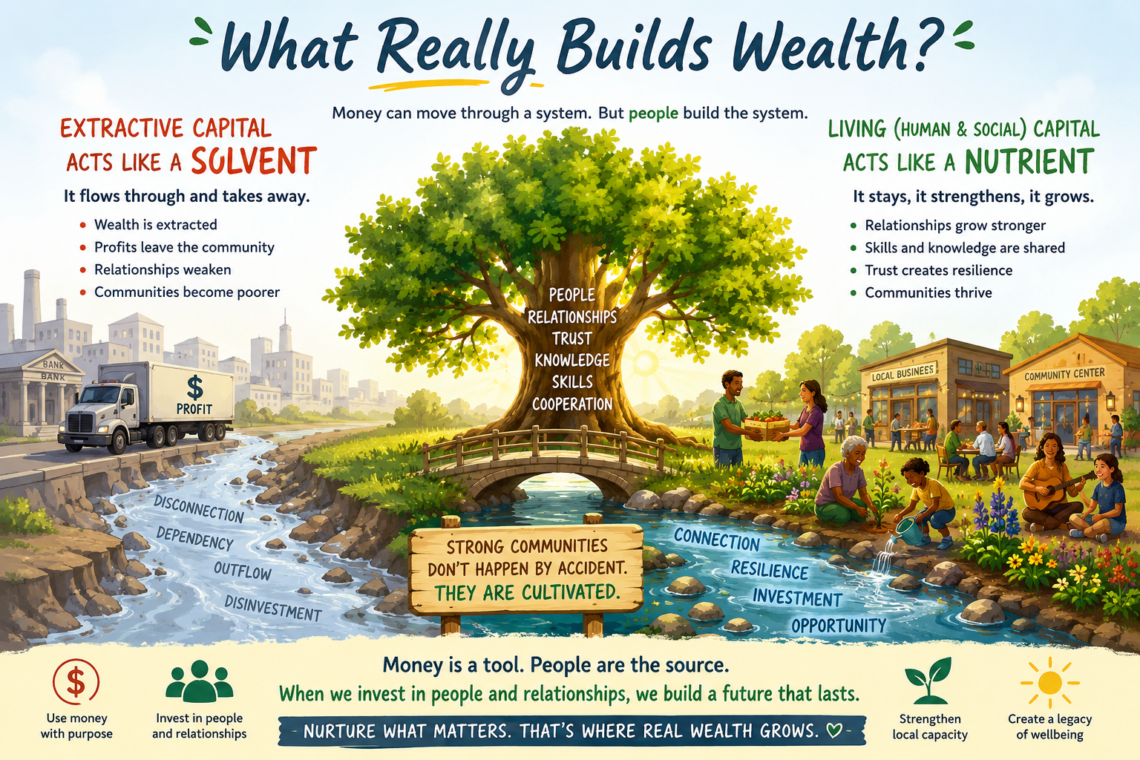
    Ernesto Van Peborgh once offered a metaphor that is, frankly… very cool. (And, thank you to Kelly Clark for telling me about it.)  He suggested that extractive capital (money) acts like a solvent as it moves through a system, while living capital (human and social capital) acts like a nutrient. The more I think about that metaphor, the more I believe that might be one of the most important ideas I’ve heard lately.  Most of us have been taught to see money as the primary measure of value. We assume that if more money is flowing, things must be getting…

  • Culture - Health and Wellness - Social and Self-Help

    Nos Misérables

    I’m watching Les Misérables and it is… tearing my heart. Is there a better depiction of the human social condition? A raw testament of how money and greed and runaway systems crush the human soul. I weep. But after the catharsis of emotion, I find there are many other issues to be considered. Les Misérables is, in many ways, about systems, communities, and what happens when society forgets that people belong to one another. And what happens when systems fail those they should be serving. The conventional reading is that Jean Valjean is redeemed through personal transformation. And that’s true. But…

  • Culture - Health and Wellness - Social and Self-Help

    Cordyceps: The Neural Network that Controls You by Marina Karlova 

    There’s an interesting YouTuber that I’ve been watching who discusses her ideas on the ills of society. And a lot of what she talks about overlaps with the themes that I’ve been exploring… memetics, social contagion, systems shaping behavior, the tension between authentic community and algorithmic culture, etc.  Her new book; Cordyceps: The Neural Network that Controls You by Marina Karlova is a psychological and philosophical self-help book that argues most human behavior is not fully self-directed, but shaped by an invisible “parasitic” social conditioning system. The title uses the real cordyceps fungus (which hijacks insects and controls their behavior)…

  • Culture - Health and Wellness - Social and Self-Help

    You Are What You Eat; Even the Junk

    One of the strangest things I noticed when I lived in France wasn’t the history, or even the slower pace of life. It was the Doritos. I’m serious. You could walk into a convenience store, buy a bag of Doritos, and they tasted different. Less artificial. Less like something engineered in a laboratory and more like something that had once been connected to actual food. That raises an uncomfortable question: “Why don’t more Americans know this?” We spend enormous amounts of money treating chronic illness. Diabetes. Obesity. Heart disease. Digestive disorders. Autoimmune conditions. Depression. Anxiety. Yet very little public conversation focuses…

  • Culture - Health and Wellness - Social and Self-Help

    Eco-Civilization

    Ecocivilization: Making a World That Works for All is, at its core, an argument that humanity’s crises are not separate crises at all. Climate collapse. Loneliness. Economic inequality. Political polarization. Ecological destruction. Mental health decline. Meaninglessness. They are all symptoms of the same deeper problem: the way modern civilization has taught us to think about ourselves and the world around us. Jeremy Lent argues that modern industrial culture is built on a worldview of separation. Human beings separated from nature. Individuals separated from community. Economics separated from morality. Growth separated from limits. We’ve been taught to see life as competition…

  • Culture - Health and Wellness - Social and Self-Help

    Short Essays Collection # 12

    I Imagine and Re-imagine Community Social Safety Nets… Social safety nets that are community-based systems able to catch those who fall through the cracks of the larger public systems. The answer to social precarity cannot be entirely top down. A big part of the answer must come from the bottom up; community based initiatives. I imagine and re-imagine community as necessary social infrastructure for the future. Because the truth is, modern life has become increasingly precarious for a lot of people. More people are falling through the cracks of large institutional systems than most societies are comfortable admitting. Economic instability.…

  • Culture - Health and Wellness - Social and Self-Help

    Modern Life and Our Dopamine Addiction

    We carry in our pockets little glowing machines that can instantly show us war, collapse, outrage, scandal, disaster, betrayal, economic panic, social conflict, and existential dread… twenty-four hours a day.  Why do we call this “staying informed”?  I don’t think most people are truly informed anymore. About anything. I think most people are just chemically trapped. And let me tell you something… dopamine is not always our friend. People talk about dopamine like it’s happiness. It’s not. Dopamine is anticipation. Seeking. Craving. It’s the neurological itch that says: maybe the next scroll will contain something important. And social media platforms…

  • Culture - Health and Wellness - Social and Self-Help

    Short Essays Collection # 4

    Humans Humans have always been shitty. Now we’re just shitty – at scale. What is Left As I continue to work my way through The Good Doctor, the episode I’m watching right now involves an artist—a painter—who must choose a brain surgery that will destroy her creative ability, but it’s the only way to save her life. And because being an artist is her identity, she would rather die. That’s making me think about the whole subject of identity, because I recently lost a huge part of mine. We all see ourselves in a particular way: as an artist, a…

  • Finance and Economy - Health and Wellness - Social and Self-Help

    Upstream Is Not Charity; When Doing Good Makes Financial Sense

    For most of modern nonprofit history, we’ve raised money by telling stories of need. We show the hungry child. The overwhelmed mother. The struggling family. And we say: “Look. Help. Please.” And there was nothing wrong with that. Compassion does matter. It always will. But I think we’re entering a new era where that model alone isn’t going to be enough. What if the future of nonprofit funding isn’t about just providing charity… but alignment? What if we stopped positioning ourselves as moral obligations and started positioning ourselves as upstream infrastructure Because, frankly, that’s what many of us actually are.…

  • Culture - Health and Wellness - Social and Self-Help

    Swimming the Mississippi of Life

    Sometimes I think living in this world is like floating down the Mississippi River. You didn’t choose the river. You didn’t choose the century. You didn’t choose the current speed or the industrial runoff or the barge traffic. You just opened your eyes one day and there you were — already moving. And the river is strong. You can swim against it. For a while. You can exhaust yourself trying to prove you’re independent of it. You can angle sideways. You can drift with it. You can dodge a branch or push away from a rock. You can grab onto…