For most of human history, the idea that a corporation could become more powerful than a government would have sounded absurd. A corporation was supposed to be a tool. A legal structure. A convenient way for people to organize economic activity. Governments governed. Corporations sold things. Simple enough. Yet if you look closely at many of the great dystopian films of the last fifty years, a recurring theme emerges. Again and again, filmmakers imagine a future where corporations no longer serve society… Society serves corporations. In RoboCop, the corporation effectively runs the city. In Alien, a corporation sends workers into…

-
-
Much of my work is often described as community building, time co-ops, social capital, trust economies, mutual aid, mutual support, human capital, or social infrastructure. And those descriptions are certainly all true. But, they’re also incomplete. What I’m really interested in is something larger: a memeplex; a set of interconnected ideas that reinforce one another and gradually change how people understand value, belonging, and society itself. At the center of this memeplex is a simple belief: people are the source of value and community is the environment where that value plays out. Money has utility. Markets have utility. Institutions have…
-
If you haven’t yet heard of Dunbar’s Number, here is a quick take from an article published in Cracked 18 years ago. Old but still relevant. David Wong’s article; “What Is the Monkeysphere?” reimagines Dunbar’s Number in a fairly humorous way. His essay points out that human empathy is not limitless, even though we might like to think that it is. But in fact, our brains “evolved” to care deeply about a relatively small number of people; family, friends, and a close social circle. Beyond that, other humans slowly stop feeling like fully real people and start becoming abstractions: crowds, statistics, headlines. Stuff…
-
Community is not a byproduct of society. It’s the foundation upon which society is built. And we seem to have gotten that backwards lately. It seems like many in our society think of community as something optional. A nice thing to have if we can find the time. A social club. A neighborhood association. A church group. A collection of people who happen to share a hobby or a zip code. As if community is an accessory attached to civilization. I don’t think that’s true at all. I think community comes first. Long before there were nations, corporations, markets, governments,…
-
A lot of modern ideology assumes humans are infinitely interchangeable units with equal ability to navigate complexity independently. But lived reality says otherwise. People vary tremendously in capacity, tenacity, perception, and adaptability. Healthy societies historically compensated for that through community, culture, and layered support structures rather than pretending everyone should operate as isolated hyper-competent individuals. That reality is highlighted (again and again) in my work on trust, networks, and social infrastructure. I’ve written frequently about high agency people over the years. The kinds of people who look at a difficult situation and instinctively think: “Okay… what can I do about…
-
One thought that struck me while crafting this piece: the history of the internet mirrors a lot of the patterns that I write about in communities. The early internet was highly decentralized. Small groups formed around shared interests. Reputation was local. Trust was relational. Discovery happened through networks of people who knew one another. As the web matured, many of those functions became centralized. Search engines replaced discovery through relationships. Social media replaced community-owned spaces. Algorithms replaced local judgment. Convenience increased, but a great deal of human texture disappeared in the mean time. That’s one reason these new movements keep resurfacing.…
-
At its core, this book is an argument that most of what modern people assume about human history is either oversimplified… or outright wrong. The standard story goes something like this: Humans started as small egalitarian hunter-gatherer tribes. Then agriculture arrived. Population increased. Cities formed. Hierarchies became inevitable. Kings, bureaucracies, armies, and inequality emerged because complexity required centralized control. Civilization, in this telling, is basically a tragic trade-off. We gained technology and lost freedom. However, Graeber and Wengrow challenge nearly every part of that narrative. Using archaeology, anthropology, and historical evidence from societies across the world, they argue that human…
-
The Problem Statement Modern systems optimized for production and consumption have systematically dismantled the social infrastructure (trust, reciprocity, belonging, mutual obligation) that once made communities strong. And this isn’t a downstream problem. It’s the upstream condition generating loneliness, institutional distrust, political polarization, and chronic dependency on systems that were never designed to replace community. Effective Altruism (EA), begins by asking one question: Is this problem large, neglected, and tractable? Yes on all three. Social capital erosion affects virtually every developed society. It is structurally neglected because its outputs (trust, connection, civic participation) are invisible to economic metrics and therefore defunded.…
-
Reclaiming Human and Social Capital as the Foundation of Economic Life A Position Paper by River Stephens Executive Summary Modern society has become extraordinarily skilled at measuring money and remarkably poor at measuring value. We track GDP, stock prices, quarterly earnings, productivity metrics, market capitalization, and countless other financial indicators. Entire industries exist to monitor, analyze, and optimize the movement of money. Yet beneath all of these measurements lies a largely unexamined assumption: that money itself is value. This paper challenges that assumption. Money is not value. Money is a claim on value. The true sources of value reside in…
-
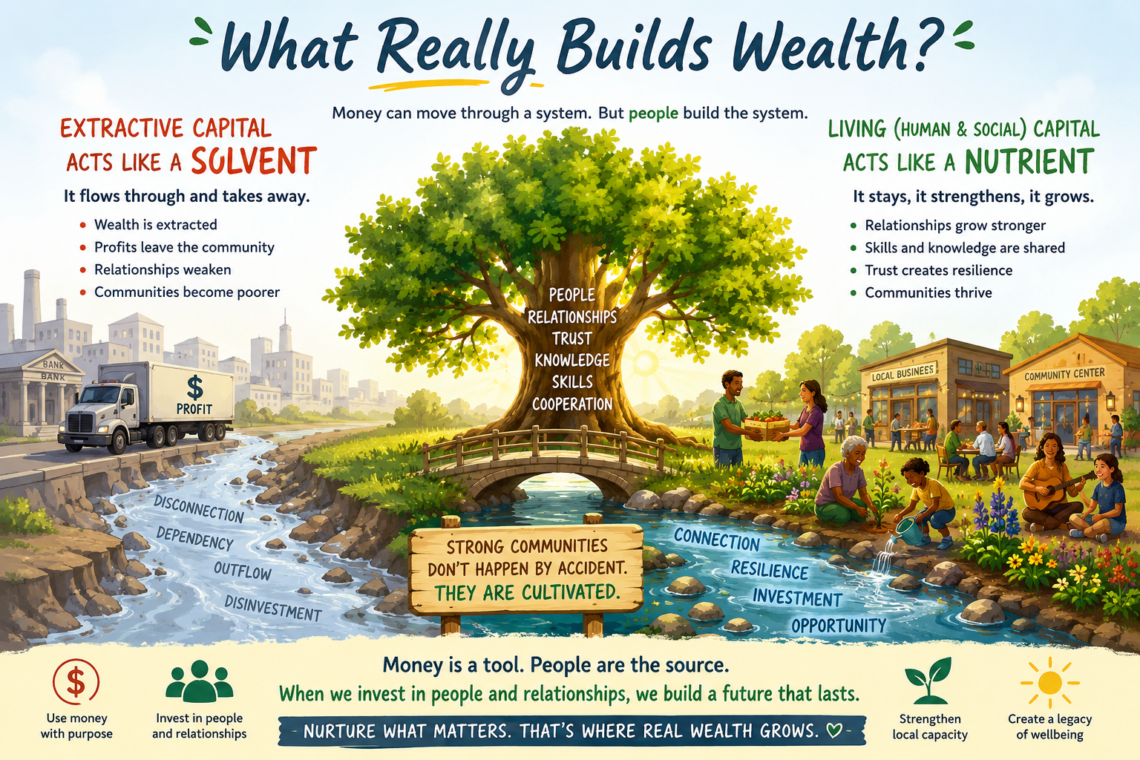
Ernesto Van Peborgh once offered a metaphor that is, frankly… very cool. (And, thank you to Kelly Clark for telling me about it.) He suggested that extractive capital (money) acts like a solvent as it moves through a system, while living capital (human and social capital) acts like a nutrient. The more I think about that metaphor, the more I believe that might be one of the most important ideas I’ve heard lately. Most of us have been taught to see money as the primary measure of value. We assume that if more money is flowing, things must be getting…